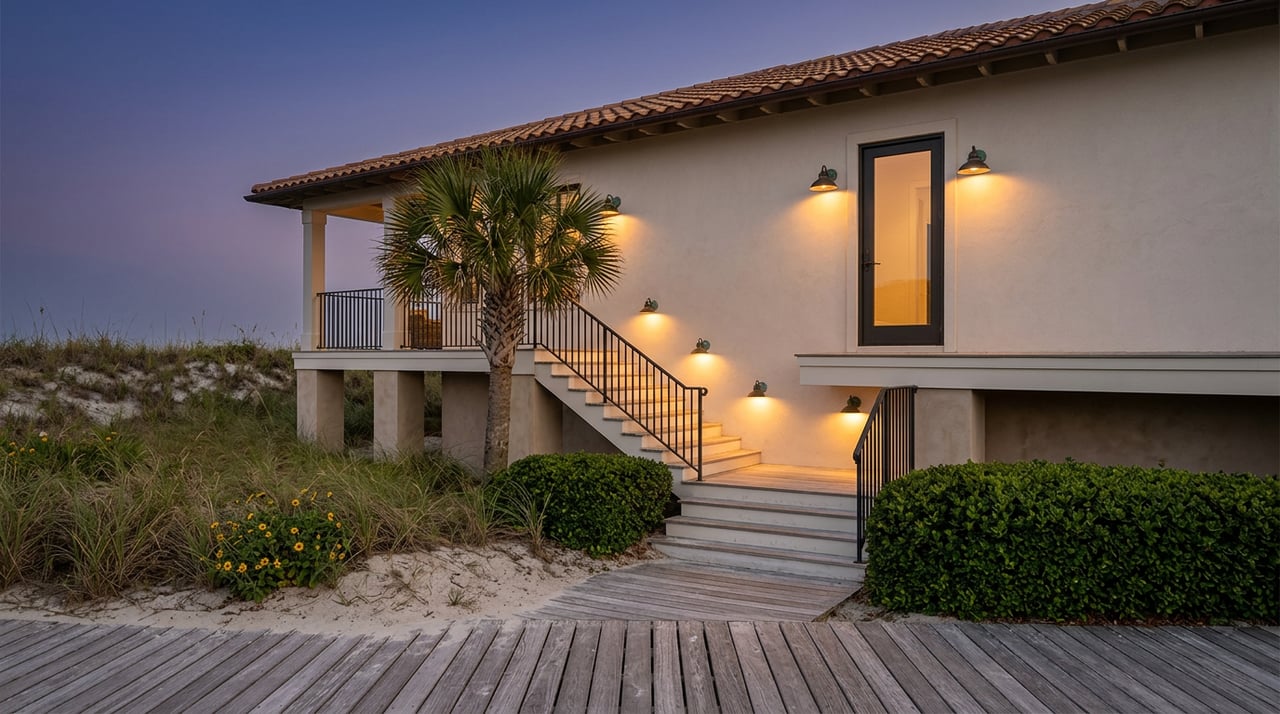
Old Ponte Vedra Beach's Porch Lights Are Part of a Live Research Project Right Now
September 3, 2026
September 3, 2026
Most people who live along Ponte Vedra Boulevard assume the beach settles down after Labor Day. The crowds thin, the rental turnover slows, and by the time September arrives, the sand starts to feel like it belongs to the neighborhood again. That assumption is mostly right about people. It is wrong about the beach itself.
Sea turtle nesting season in this part of Florida runs from May 1 through October 31, and the Flagler College Gargoyle has reported on the work of Mickler's Landing Turtle Patrol along the 4.6-mile stretch between Sawgrass Beach Club and the Guana Tolomato Matanzas National Estuarine Research Reserve. The group has been out on that sand every morning since mid-April, thirty minutes before sunrise, marking nests and checking on ones already laid. If you have walked past a taped-off square with a wooden stake and a small sign warning people to stay off, that is not landscaping. It is an active research site, and this year it started earlier and is running longer than usual.
Mickler's Landing Turtle Patrol, known locally as MLTP, patrols under a Florida Fish and Wildlife Conservation Commission permit held by Lucas Meers, who also directs Jacksonville University's Sea Turtle Program. Meers and a rotating team of community volunteers and JU students walk the beach every morning during nesting season, checking for new crawls overnight and monitoring existing nests for predation, washovers, or anything else that could affect whether the eggs survive. Every nest on that stretch is checked daily until it hatches.
That level of attention is not typical of every beach in Florida. Most nesting programs check a few times a week or rely on volunteers covering shorter sections. MLTP's collaboration with Jacksonville University became a named program on World Sea Turtle Day, June 16, and the data collected on these morning walks feeds directly into ongoing research on loggerhead foraging grounds, nest site fidelity, and maternal lineage. It is a permitted research operation, and the beach behind Old Ponte Vedra Beach homes is one of its field sites.
If you assumed the season was winding down by late August, the timeline argues otherwise. MLTP recorded its earliest loggerhead nest ever on April 26, 2026, five days before the official season even opened. Sea turtle eggs typically take about two months to incubate, which means hatchlings from that nest were likely emerging by late June, well ahead of the usual midsummer timeline, and the activity has continued since. Earlier, on August 2, MLTP fielded a call from a beachgoer who spotted a female emerging south of Mickler's Landing with the clear intention to nest. Late-summer activity on this beach is not an anomaly. It is the norm most years, and the calendar cutoff of October 31 is more of a guideline than a hard stop.
That was true in 2024 as well. A green sea turtle nest laid in mid-September became something of a neighborhood fixture that year, closely followed by residents who kept asking Meers for updates. The nest hatched so late that MLTP did not complete its final evaluation until November 21, three weeks after the official season had closed on paper. If a nest is still incubating when the calendar turns to November, the patrol does not stop showing up because the season is technically over.
Here is how this year's activity compares to the recent baseline:
| Measure | 2024–2025 baseline | 2026 status |
|---|---|---|
| St. Johns County total nests | 999 documented in 2025, a slight increase over 2024 | Season still active through October |
| Statewide loggerhead nests | Tracked annually by FWC | 94,667 documented through June 30, the highest June total in five years |
| Statewide leatherback nests | Typically a few hundred per season | 2,152 documented through June 30, an unprecedented pace |
The St. Johns County number looks modest next to the statewide loggerhead count, and that gap is worth sitting with for a second. Most of the state's nesting volume happens on beaches further south. What makes this stretch of Ponte Vedra Beach notable is not raw quantity. It is that a single, permitted, university-linked patrol is checking every nest here daily, which means the data coming off this particular beach is unusually granular compared to counties that rely on periodic surveys.
The research goal here is not just counting nests. MLTP collects samples that help scientists understand where loggerheads forage, whether individual females return to the same stretch of beach across nesting cycles, and how mothers and hatchlings are related genetically. That kind of data, gathered consistently over years, is what eventually shapes policy, including decisions about construction near the dune line, future beach renourishment projects, and lighting rules for beachfront properties.
That last point is the one that actually touches daily life for anyone whose porch, pool deck, or upstairs windows face the Atlantic. Artificial light causes what patrol volunteers call a false crawl, when a female comes ashore to nest, senses the light is wrong, and returns to the water without laying eggs. It also disorients hatchlings once they emerge, since newly hatched turtles instinctively crawl toward the brightest horizon, which should be moonlight on open water and not a porch light or pool lamp. Every false crawl and every disoriented hatchling event gets logged as part of the same dataset MLTP is building with Jacksonville University. In a very literal sense, the decision to leave a porch light on after dark during nesting season becomes a data point in an active research file, not just a personal preference.
St. Johns County and MLTP ask residents and visitors to follow a short list of practices through October 31, and most of them are easy to fold into an evening routine that beachfront homes here are already used to:
The county also closes vehicular beach access gates at 7:30 p.m. and reopens them at 8 a.m. through the end of October, specifically to keep the beach clear overnight. None of this is new guidance invented for this season, but the volume of activity this year, combined with a nest count on pace to challenge recent records statewide, makes the timing more relevant right now than it would be in a slower year.
The part of this that most residents never realize is that the research is not hidden. MLTP hosts public nest evaluations later in the season, when volunteers dig into an already-hatched nest to determine how many eggs hatched successfully. These are open to anyone, no registration required, and they sometimes end with a live hatchling release if timing and conditions line up. The group also runs an Adopt-a-Nest program starting at fifty dollars, done in partnership with Jacksonville University, which comes with an invitation to your nest's evaluation for up to five people. It is one of the few ways to watch actual field research happen on a beach most people only think of as a place to walk the dog or catch a sunrise.
Two months of nesting season remain on the calendar, and based on this year's pace and the 2024 example of a nest that wasn't fully evaluated until three weeks after the season's official close, the real end date could land later than October 31 again. For anyone who lives along this stretch of coast, that means the stakes in the sand, the volunteers out before dawn, and the porch light switch by the back door are all part of the same story through the rest of the fall.
If you're weighing a move to this stretch of coast, or simply curious what living behind an active research beach actually looks like day to day, Connolly Homes has spent decades learning the details that make Old Ponte Vedra Beach what it is. Reach out to Suzie and Rory Connolly for a conversation grounded in the neighborhood, not just the listing sheet.
This article is general information, not legal, tax or financial advice. Consult a qualified professional about your situation.
Stay up to date on the latest real estate trends.



Why Ponte Vedra Beach for Retirees Is One of Florida's Top Destinations.

A Local's Guide to the Most Relaxing and Healing Activities in Ponte Vedra Beach, Florida.

Clever Small Space Interior Design Tips for Compact Beach Homes.

A Guide to the Finest Gated Communities in Ponte Vedra Beach, Florida.
With a strong work ethic ingrained from a young age, Rory, alongside his experienced mother, Suzie Connolly, at Ponte Vedra Club Realty, is dedicated to helping you find your perfect home. His background in finance adds a strategic edge to the process. Join Rory in building a thriving community, let's make your dream home a reality!