In Old Ponte Vedra, "No HOA" Doesn't Mean No Rules
September 24, 2026
September 24, 2026
For a buyer coming from a gated community with a thick covenant binder, local land-use rules can still matter.
The sections below describe local requirements that can shape renovation and rebuilding plans.
S.J. Law Group describes PVARC as evaluating building design, landscaping, lighting, signage, and site layout for compatibility with the surrounding neighborhood.
A notable example of PVARC's role came in 2017, when, as the Ponte Vedra Recorder reported, the Ponte Vedra Inn & Club sought approval to demolish its existing Ocean House and replace it with two new buildings. The district's regulations cap most structures at two stories and 35 feet. The club sought to build to 43 feet, citing updated base flood elevation requirements that pushed the finished floor several feet higher than the original structure. Residents pushed back hard at the hearing. One resident told the committee he didn't want the corridor to become "another Atlantic Beach, another Miami." PVARC ultimately recommended approval anyway.
For an ordinary homeowner, the case offers a look at PVARC's involvement in a large project. St. Johns County's PVARC meeting calendar lists meetings on the fourth Wednesday of each month; a county PVARC agenda gives the Ponte Vedra Public Library as the meeting location.
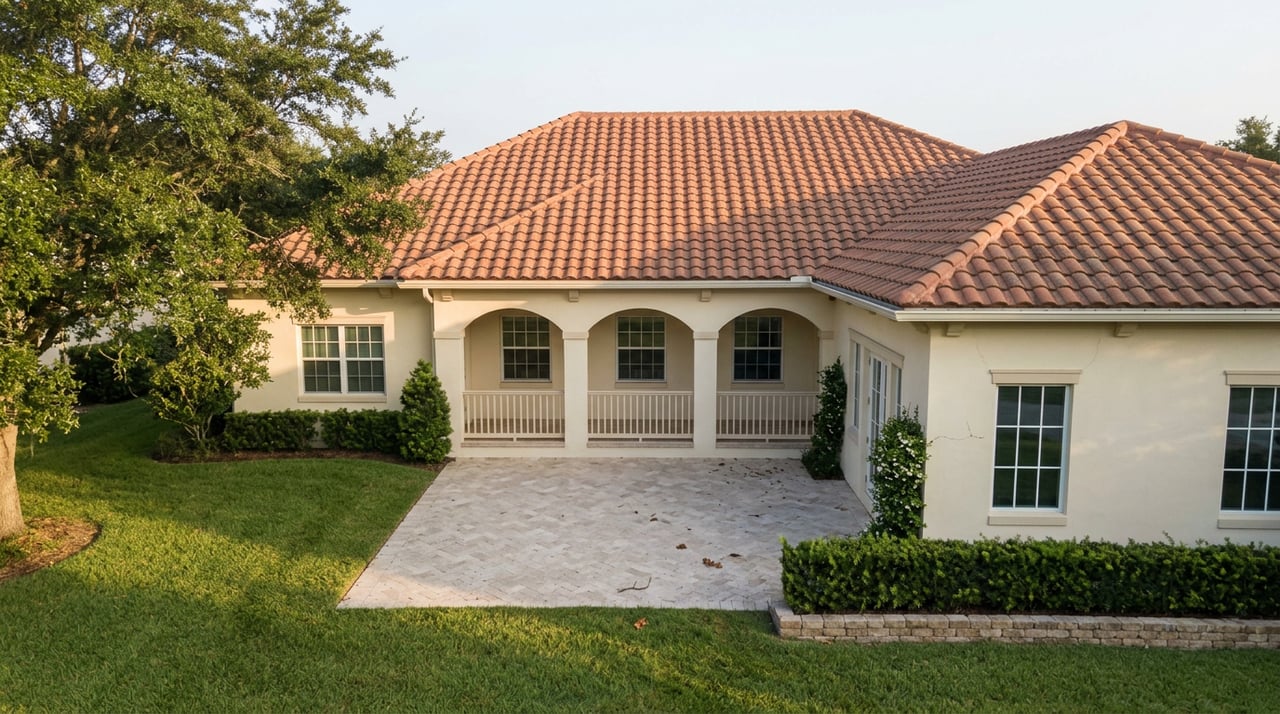
Old Ponte Vedra was the first area of Ponte Vedra Beach to be developed, and most of its housing stock dates to the 1960s and 1970s, built as second homes on generous lots. That vintage stock is now the target of steady teardown activity, with older ranch houses coming down to make way for new two-story construction on the same footprint.
The district's regulations cap most structures at two stories and 35 feet. For most homeowners that's not a hardship. It's a ceiling most new construction in the area already respects.
Old Ponte Vedra's other defining feature, alongside the teardown boomlet, is its tree canopy. Live oaks that predate most of the houses around them are part of what gives the streets their character, and the county has written that into the zoning district's rules directly.
Under St. Johns County Ordinance 2020-38, a Protected Tree Removal Permit is required before a protected tree can be cut down, destroyed, or removed. St. Johns County code-compliance guidance says that tree removal on lots under an acre with an existing home generally does not require a permit unless the tree is a specimen tree, but the Ponte Vedra Zoning area requires a permit for any protected tree. If mitigation is required, replacement trees can't be planted within five feet of a property line.
For a buyer planning a teardown, this is worth confirming before waiving the inspection period rather than after the demolition crew shows up. A grand oak sitting where your new footprint needs to go makes it especially important to confirm whether a permit is required before demolition.
Here's the detail that catches even experienced buyers off guard. The St. Johns County Ponte Vedra Zoning District code update says that for any lot platted before January 1, 1998, the minimum yard setback is determined by the Building Restriction Line shown on the original plat, whatever that line happened to be when the lot was subdivided decades ago.
Old Ponte Vedra's lots were platted in waves going back to the 1930s. A survey that shows a generous buildable envelope on one lot says nothing about the lot next door. Before finalizing plans for a rebuild or a major addition, it's worth having a surveyor confirm which setback standard actually governs your specific parcel, rather than assuming the county's current baseline applies uniformly across the neighborhood.
None of this makes Old Ponte Vedra difficult to transact in. It makes it a place where the due diligence looks different than it does in a gated community with a standard HOA packet. A few things worth doing before you're under contract or committed to a renovation timeline:
None of these steps are unusual for a coastal property with this much history. They're just different from what a buyer moving in from a private HOA community expects to encounter, and knowing which questions to ask before closing saves real time on the other side.
Old Ponte Vedra's regulatory structure is one more reason buyers and sellers here benefit from someone who has actually sat through the process, not just read the zoning code. If you're weighing a purchase, a rebuild, or a sale in Old Ponte Vedra, Rory Connolly can walk you through what your specific lot allows before you're locked into a contract.
This article is general information, not legal, tax or financial advice. Consult a qualified professional about your situation.
Stay up to date on the latest real estate trends.


Why Ponte Vedra Beach for Retirees Is One of Florida's Top Destinations.

A Local's Guide to the Most Relaxing and Healing Activities in Ponte Vedra Beach, Florida.

Clever Small Space Interior Design Tips for Compact Beach Homes.

A Guide to the Finest Gated Communities in Ponte Vedra Beach, Florida.
With a strong work ethic ingrained from a young age, Rory, alongside his experienced mother, Suzie Connolly, at Ponte Vedra Club Realty, is dedicated to helping you find your perfect home. His background in finance adds a strategic edge to the process. Join Rory in building a thriving community, let's make your dream home a reality!